After launch
Scoring and airdrops: how play becomes a place and a share
“How scoring works” is the site's rules page: what counts when your players play, how their place on your game's board is made, and how that place becomes a share of your game's airdrop once it graduates. This page sums it up; if the two ever differ, the rules page wins.
The site is in English. Headings and labels are quoted here exactly as they appear on screen.
Elixir Games is a test version on Solana devnet. Seasons, scores and airdrops here are rehearsals with test money that has no real value. The rules describe how the site works; they are not a promise of payment. More in the test version.
Where to find the rules
Press “Scoring” in the footer of any page, or “How scoring works” in the Arena, or go to
elixir.games/how-scoring-works. A list on the left jumps to each part:
“The two layers”, “What counts in Season 1”, “What a rank is made of”, “How a run is checked”,
“Goals in Season 1”, “Where the fees go” and “What we never do”.
What the rules say
-
The two layers: your game's board, and the season score
Per game. Once a game graduates, each season pays 25% of what its airdrop vault still holds. A player's rank on that game decides their share of that season's pool, up to 0.5% per wallet. On a game with 200 wallets or fewer on its board, every wallet that is paid gets that same cap, whatever its rank.
Across games. Play on every game in the Arena also adds up to one season score, ranked in the Arena. It pays nothing: airdrops are paid game by game, from each game's own board (see Leaderboards).
An airdrop vests. 25% can be claimed as soon as the game's airdrop opens, and the other 75% is released daily over the 90 days that follow. Players have 365 days after vesting ends to claim. After that, what is still unclaimed can be recovered: the service that runs the claims keeps its fee, and of the rest 30% is burned, 40% goes to the Elixir treasury and 30% goes back to the game's later seasons.
The rank shown is the rank paid. One ranking serves the board and the airdrop. A share goes to a wallet, so a season played without one is not paid. And if the same wallet shows in more than one place on a board, none of those places is paid.
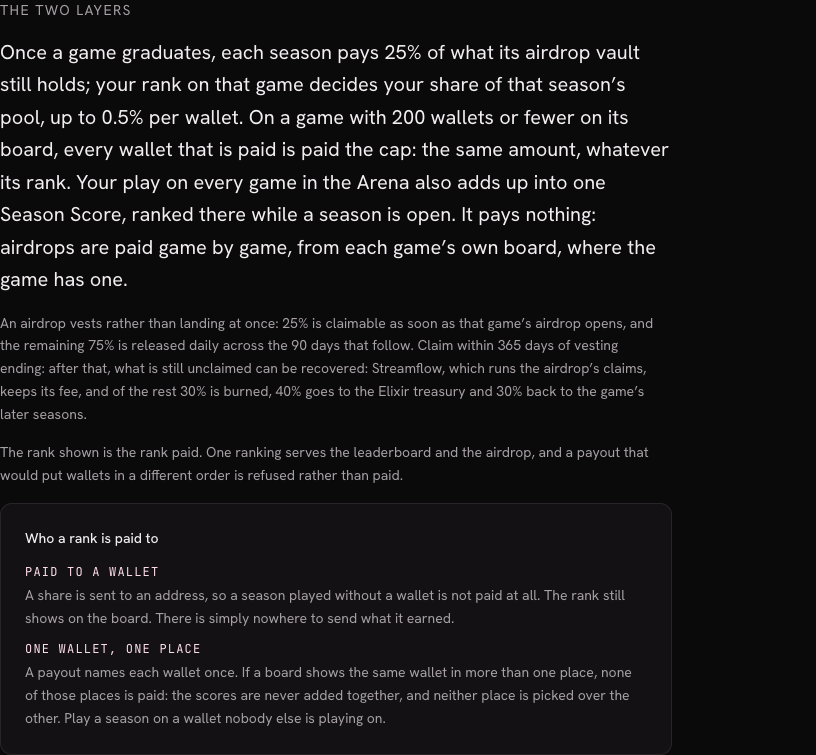
“The two layers”, with the box “Who a rank is paid to”. -
What counts
Four figures. 4 hours of play counted per day, per game, so a tab left open all night cannot outrank someone who sat down and played. +5% a day for coming back, up to 14 days in a row. 500 points across the default goal set: goal points are added to a score, never multiplied into it, and at 100 points to 1 score the whole set is worth up to 5 score. In any season that opens now, goals add at most half of what a player's play has earned, so one goal never outweighs playing. And 0.5% of a game's season pool per wallet: what the cap takes off one wallet goes to the ranked wallets that are not at the cap, and what too small a field cannot carry stays in the game's airdrop vault for its later seasons.
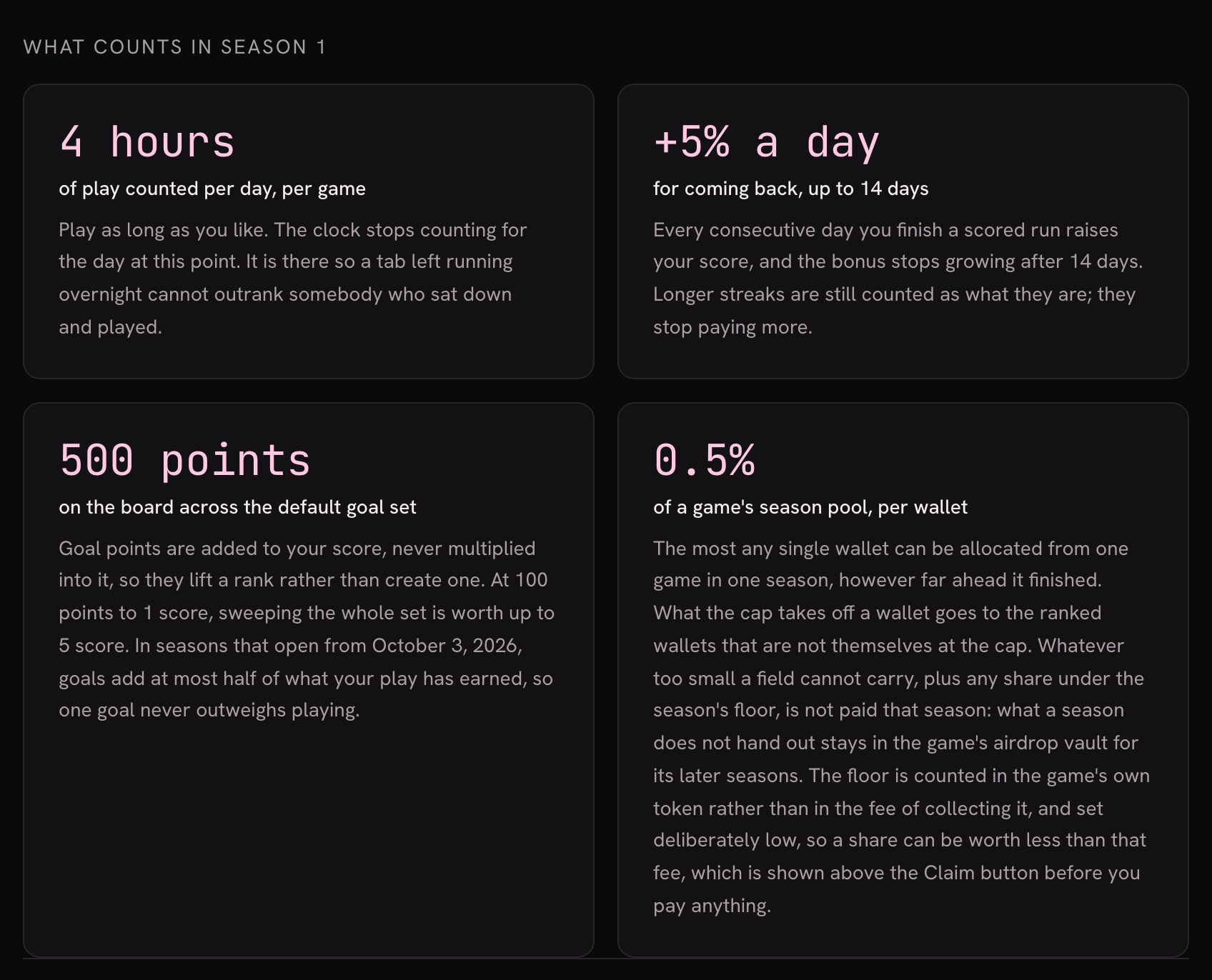
“What counts”, on the rules page. -
What a rank is made of
Four things are multiplied together, and goal points are added on top: how many play sessions a player finished (an unfinished one counts for nothing), how long they played (up to 4 hours a day), where their best score sits against everyone else's (last place among many still counts for 10%, never nothing) and their streak of days with a scored run (+5% a day, up to 14 days). If any of the four is zero, there is no rank. Only play inside the season counts, and the board freezes when the season closes.
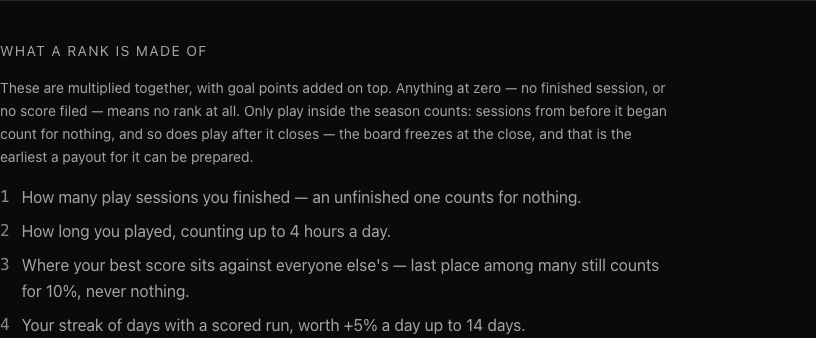
“What a rank is made of”. -
Goals, fees and checks
Goals. “Goals in Season 1” lists the default goals every game runs unless its creator sets a list of its own, and the limits on what a creator may ask for. How you set yours is in Player goals.
Fees. “Where the fees go” states how every trading fee is split: 40% of it is yours. How creators earn explains it.
Checks. “How a run is checked” names the games whose ranked daily runs are replayed to confirm their score, and says what a player is told when a run does not count.
-
What we never do
Promotion is never sold: a featured shelf or an editor's choice cannot be bought by any creator, and no rank can be bought. Nobody reviews a launch. And the scoring rules never change in the middle of a season: a game's goal list is locked from the day its season opens, so a change starts with the next season.
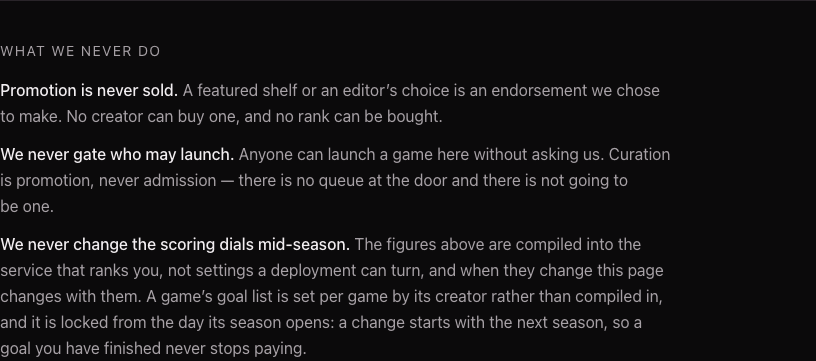
“What we never do”.
What this means for your game
- No airdrop before graduation. Your board ranks players from the start, but your game's airdrop pays only once it has graduated, one season at a time.
- Players need a wallet to be paid. A guest can rank, but a share needs an address to go to.
- Your goals lift ranks, they do not make them. Goal points add on top of play and can never outweigh it.
- You cannot change the scoring. The figures are the same for every game. What you choose is your game's goals.