After launch
Portfolio: your game tokens and what they are worth
Portfolio shows every game token your wallet holds, how much ELIX you would get for it if you sold it all now (after fees), and how much you have gained or lost on it. If you launched games, your creator earnings are there too.
The site is in English. Button and label names are quoted here exactly as they appear on screen.
Elixir Games is a test version on Solana devnet. ELIX and every game token here are test money with no real value: nothing you see in Portfolio can be turned into real money. More in the test version.
How it works
-
Open Portfolio and sign in
Press “Portfolio” in the footer of any page, or go to
elixir.games/portfolio. Tokens are held by a wallet, so the page needs one to read: without it, it asks you to sign in. Playing as a guest keeps your game progress, but a guest owns nothing on chain.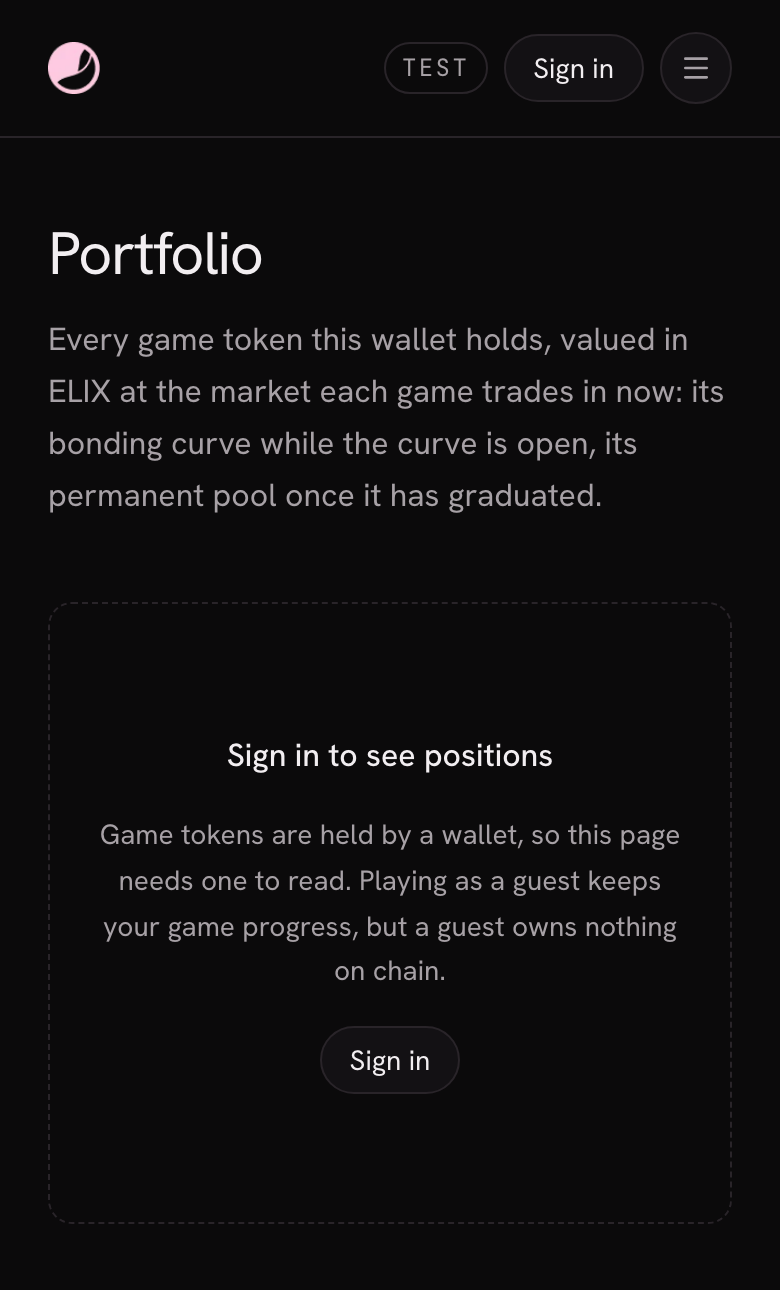
Before you sign in. -
Read the figures at the top
“Total value” is everything you hold, in ELIX. The figure beside it adds up your gains and losses, split under it into “Realised” (what you made or lost on what you already sold) and “Unrealised” (what selling what you still hold would make or lose now). Under them: how many games you hold, your wallet, the times your holdings, prices and trades were read, and “Refresh” to read them again. On a phone the two big figures stack, each one in full.
-
Read each game's card
One card per game, with its stage (“On the curve” or “Graduated”) and how many tokens you hold. The big number on the right is what you would receive if you sold the whole position now, after fees: it reads “ELIX if sold now”, with its share of your portfolio. It is the same quote the buy and sell panel gives on the game's page.
Below it: “Price” (with the market it comes from, its curve or its permanent pool), “At price” (your amount times that price), “Avg cost” when the site can work it out, and “Realised” and “Unrealised” for that game. Selling a large amount moves the price, so when selling it all would get much less than “At price”, the card says so in one sentence: “Selling all of it at once gets … ELIX, not …: a sale this size moves the price, and the trade fee comes off it.” Press a card to open the game's page.
If you hold tokens that were never bought on the site, the card says so: they carry no cost here, so their whole value counts as unrealised gain.
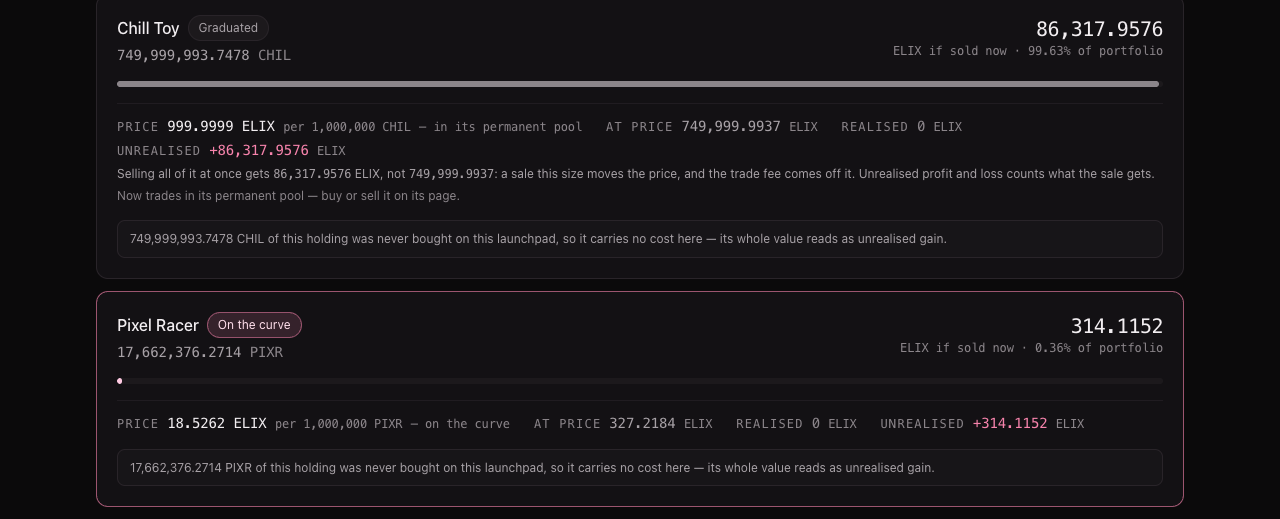
Two cards from a test wallet: a graduated game and one still on its curve. -
Further down
“Positions you closed” lists games you traded but no longer hold; what those trades made or lost stays in the total. If your wallet launched games, “Creator earnings” shows your share of their trading fees, with a “Claim” button per game (see Creator earnings). If your wallet earned an airdrop by playing, “Your airdrops” shows it, with what claiming it costs written before its “Claim” button.
-
While it reads, and if it cannot
Holdings are read live from the chain, which can take a few seconds. Meanwhile the page shows grey outlines and “Reading what … holds…”. If the network is slow it says so and asks again by itself. If the reading never comes back, it says “Your positions could not be read” and offers “Try again”. It never shows a zero it did not read.
What it does not do (yet)
- It does not buy or sell. Portfolio only shows. To trade, open the game's page.
- Gains and losses come from your newest trades. If your wallet has made many transactions, an orange note says only the newest ones could be read, and the cost and gain figures cover just that part of your history.
- Test money. ELIX and game tokens here have no real value.